By Diann Cohen, VP Client Services and Dean of Education at Macro-Pro, Inc.
Multiple subpoenas to one facility often raises a red flag. At first glance, it can look excessive; it can even look intentional.
Recently, I received a call from a district attorney’s office regarding this exact issue. They were preparing to take action (the exact wording was “raid”) against an applicant copy service business, believing the number of subpoenas served to a single location indicated fraudulent behavior.
After a short conversation and a bit of education, the situation became clear. What they thought was fraud was, in fact, the copy service following proper protocol. Most claims departments don’t consider or understand how most facilities/custodians of records are actually structured. My hope for this article is to dispel the notion that one subpoena will work for every facility.
One Location Does Not Mean One Custodian
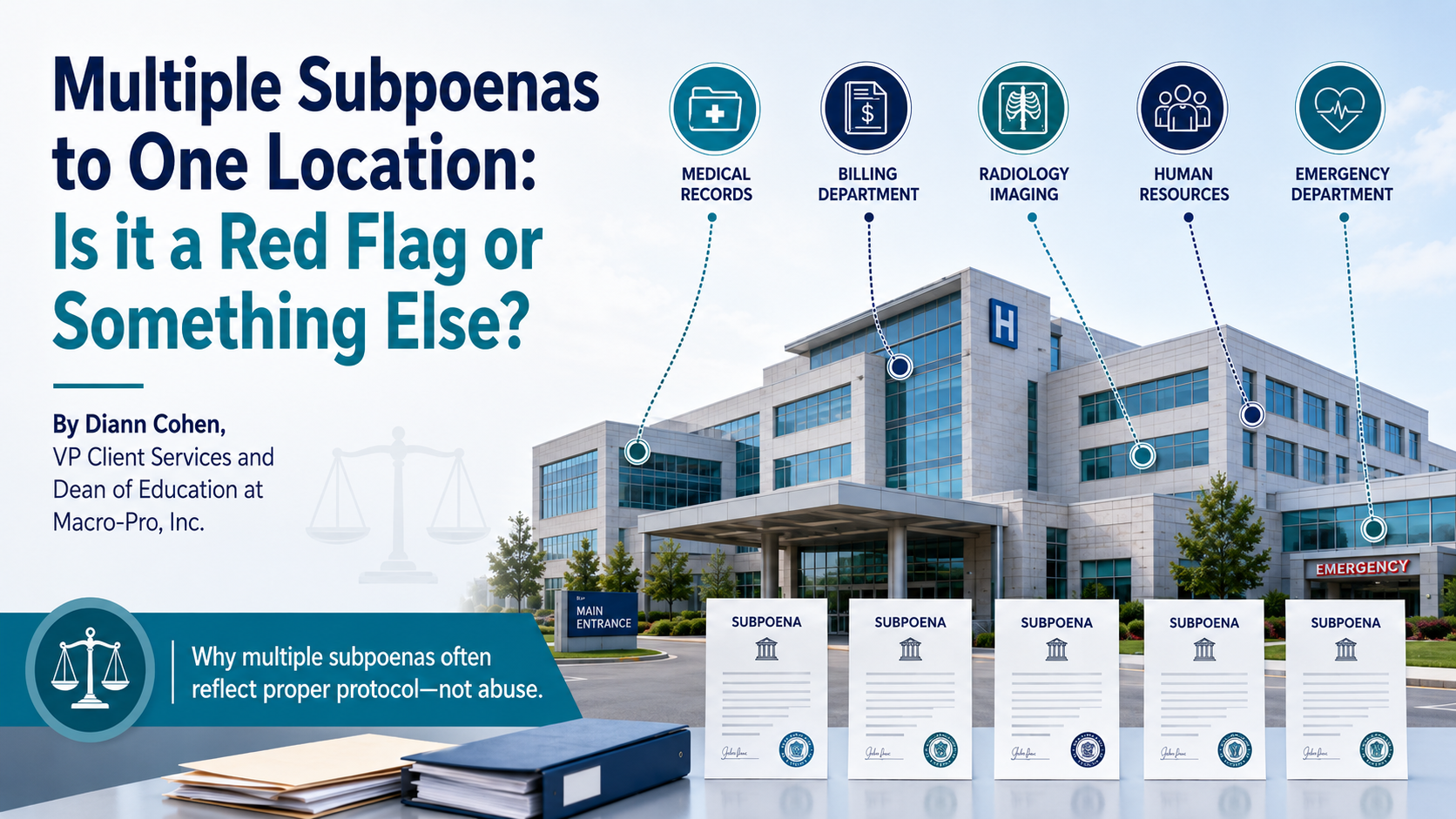
This is where the misunderstanding begins. Many large facilities operate under the same address but function with multiple independent departments. Billing, medical records, radiology, contracted emergency departments, outside billing, HR, and other departments often have separate custodians of records. Under California law, records must be produced by the custodian of records or other qualified witness in response to a subpoena. (See California Evidence Code §§ 1560–1561.)
Each of these departments:
- Has an assigned custodian.
- Maintains its own records
- Follows its own release procedures
- Requires its own properly directed subpoena
What appears to be duplication is often just compliance.
Why Multiple Subpoenas Are Required
Each department is responsible for maintaining records that may require a subpoena directed specifically to that custodian. If a subpoena is not properly directed, the records will not be produced.
In practice, this often results in:
- Separate Subpoenas Duces Tecum (SDT)
- Separate responses from each custodian
- Additional time if the request is not properly structured from the start
Copy services are not creating this structure. They are navigating it.
Workers’ Compensation Compliance Matters
In California workers’ compensation matters, copy services must also comply with the Copy Service Fee Schedule (Title 8, California Code of Regulations §§ 9980–9984).
These regulations require that services be:
- Reasonable
- Necessary
- Properly documented
When multiple custodians exist, serving each one may be required to obtain the records relevant to the claim.
The Cost of Getting It Wrong
When subpoenas are not served the first time correctly, the consequences are predictable:
- Missing records
- Delayed decisions
- Additional subpoenas
- Increased costs due to rework
What may have looked like “too many subpoenas” is actually what is required. It is the facility that determines when and where the SDT must be served based on the records being requested. When multiple subpoenas are served to what appears to be a single location, it is often because the copy service is following the requirements necessary to obtain records from each responsible custodian.
Following the protocol is not abuse. There is a difference between overuse and proper execution. Not doing so would be inefficient, ultimately more costly, and cause delays.
When handled correctly, this approach:
- Ensures records are produced the first time
- Reduces delays
- Prevents duplication of effort
- Supports timely and accurate claim decisions
The Takeaway
Multiple subpoenas to one location are not necessarily a sign of abuse. More often, they are a sign that the process is being handled correctly. When copy services follow the structure required to obtain records, they do not add cost—they prevent delays, reduce rework, and ensure the right records are obtained the first time.
It is worth noting that hospitals and larger facilities typically require multiple subpoenas. Places like independent doctors’ offices and chiropractic offices, or smaller employers, for example, usually require only one subpoena.
Some examples of facilities requiring separate subpoenas:
All hospitals and clinics for: UC Regents, Providence, Sutter, Hoag, Desert Regional, John Muir, Alta Bates, Dignity Health, Kaiser, Scripts, Stanford, Cedars Sinai. There are more in every state.
Insurance companies: Request separate subpoenas for each claim.
WCAB: Separate requests for each claim.
Should you have any questions on this matter, please reach out to me at [email protected].